
What Is the CAP Theorem?
The CAP theorem, also called Brewer's theorem, says that during a network partition a distributed system must choose between strong consistency and availability while still tolerating the partition.
In today's always-on digital world, applications are expected to be fast, reliable, and available at all times, even when traffic spikes or servers fail. To meet these expectations, modern systems store and process data across multiple machines instead of relying on a single server. While this distributed approach improves scalability and fault tolerance, it also introduces a fundamental challenge: how do you keep data consistent when it is spread across many nodes? That is where the three CAP properties come in: Consistency, Availability, and Partition Tolerance.
Understanding the CAP Theorem is essential for system designers, backend engineers, and anyone building large-scale applications. It helps explain why some systems choose to serve slightly stale data instead of failing, why others prefer rejecting requests during outages, and why there is no perfect distributed database. This article breaks down the CAP theorem in simple terms, connects it to real-world system design decisions, and links it with related topics such as consistency models and database scaling.
The Origins of CAP
The idea behind the CAP Theorem emerged at a time when distributed systems were becoming more common, but their limitations were not yet clearly understood. In the late 1990s, engineers were increasingly building systems that spanned multiple machines, often across data centers, to improve scalability and reliability. However, failures related to network delays, message loss, and partial outages were difficult to reason about, and system behavior during such failures often surprised developers.
In 2000, Eric Brewer, a computer scientist at UC Berkeley, presented a key insight during a keynote talk at the ACM Symposium on Principles of Distributed Computing. He argued that in the presence of a network partition, when nodes cannot communicate reliably, a distributed system must make a hard choice: it can either remain consistent or available, but not both at the same time. This observation later became known as Brewer's Conjecture.
Two years later, in 2002, researchers Seth Gilbert and Nancy Lynch formally proved this conjecture, giving it a solid theoretical foundation. Their proof clarified the conditions under which the trade-off applies and cemented CAP as a theorem rather than just an intuition. It also showed that network partitions are not rare edge cases but an unavoidable reality in distributed systems, especially those operating across wide-area networks.
The origins of CAP reshaped how engineers think about system design. Instead of trying to achieve all desirable properties at once, architects began explicitly choosing which guarantees mattered most for a specific use case. This shift in thinking helped shape modern distributed databases, NoSQL systems, and cloud-native architectures, where trade-offs are treated as deliberate design decisions rather than accidents.
Breaking Down the Three Properties
Consistency (C)
In the CAP context, consistency means strong consistency. Every read operation returns the most recent write or fails with an error. Once a write is acknowledged by the system, all nodes must behave as if they see the same value.
A simple real-world example is a bank balance. If you withdraw money from one ATM, any other ATM or banking app should immediately reflect the updated balance. Showing an old balance could lead to overspending, which is unacceptable in this scenario.
Strong consistency makes systems easier to reason about, but it becomes harder to guarantee when data is replicated across many machines and locations.
Availability (A)
Availability means that every request receives a non-error response, even when parts of the system are failing. The system must keep responding, although the response may not contain the most recent data.
A typical example is a large e-commerce website. Even if some backend services are overloaded or temporarily unreachable, the site may still allow users to browse products or place orders using slightly stale data rather than showing an error page.
Availability prioritizes user experience and uptime, but it may come at the cost of returning outdated information.
Partition Tolerance (P)
Partition tolerance means the system continues operating even when some nodes cannot communicate with each other. Partitions can occur due to packet loss, network failures, routing issues, or complete data center outages.
In real-world distributed systems, network partitions are not rare or exceptional. They are inevitable. Messages will be delayed, dropped, or lost, especially in systems spread across regions or continents. Because of this reality, partition tolerance is usually treated as a requirement, not an optional feature.
Once a partition occurs, the system is forced to choose between consistency and availability, which is the core tension described by the CAP Theorem.
The True Meaning of the CAP Theorem
The true meaning of the CAP theorem is simple: when a network partition happens, a distributed system cannot fully guarantee both strong consistency and availability at the same time. It must choose which property to favor while still tolerating the partition.
The key point is that CAP applies when communication between nodes breaks down. It does not mean a system permanently loses one property in every situation. When the network is healthy, many systems can appear to provide consistency, availability, and partition tolerance together for normal day-to-day operation. The real trade-off shows up when a partition happens and nodes can no longer coordinate reliably.
The Three CAP Categories
Based on how systems handle the trade-offs between consistency, availability, and partition tolerance, distributed systems are commonly grouped into three CAP categories. These categories do not describe implementation details, but the priority a system chooses when failures occur.
These labels are best treated as mental models, not perfect permanent boxes. Real production systems often expose tunable consistency levels, different read modes, or different behavior across single-region and multi-region deployments.
CAP relationship
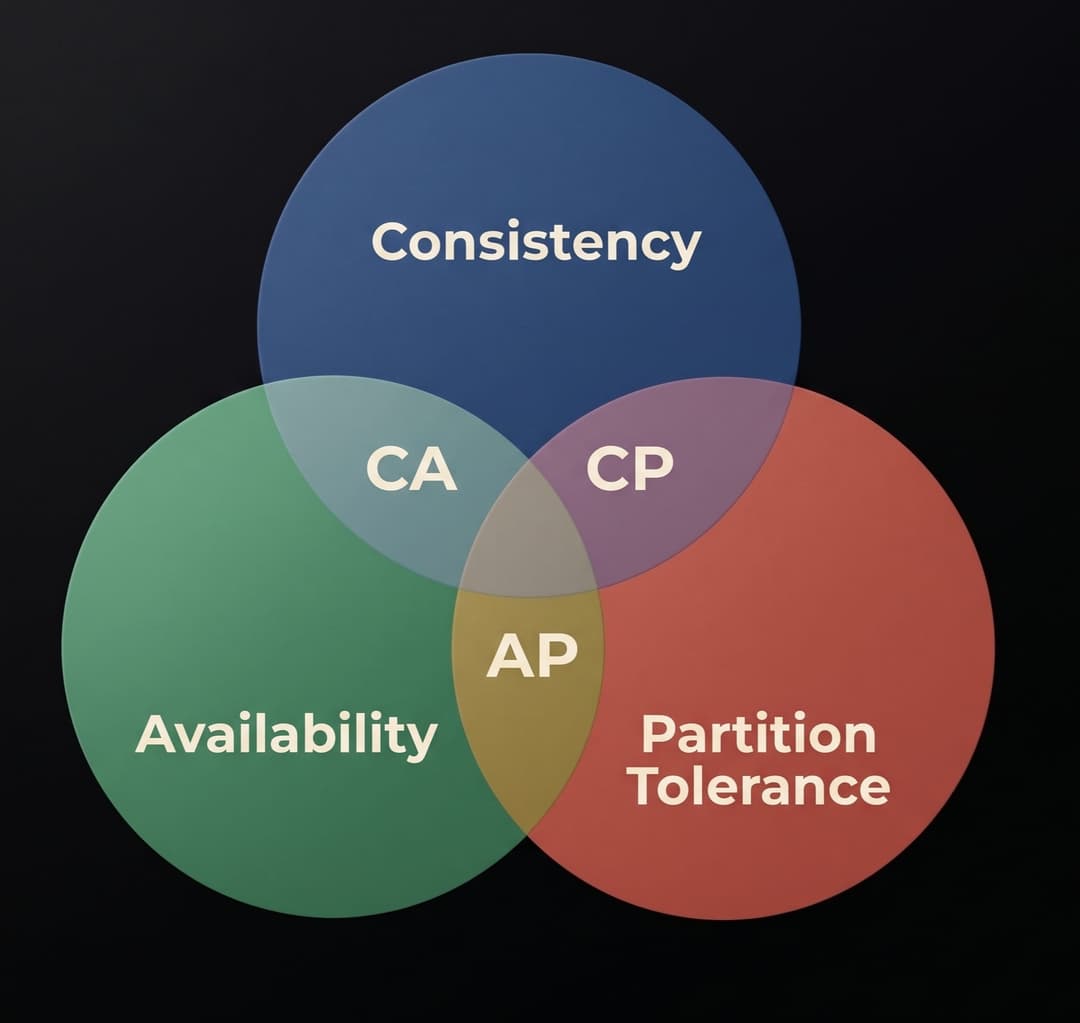
During a network partition, a distributed system usually has to choose between keeping data fully consistent or staying fully available while still tolerating the partition.
CP Systems
CP systems prioritize consistency and partition tolerance. When a network partition occurs, these systems may reject reads or writes rather than return stale, incomplete, or conflicting data.
In other words, if the system cannot guarantee that all nodes agree on the same value, it prefers to fail fast instead of risking incorrect results.
This approach is well suited for domains where correctness is critical and wrong data can cause serious problems. Common examples include banking and financial transactions, inventory and stock management, distributed locks and coordination services, and reservation or booking systems.
In CP systems, a temporary outage is considered safer than returning incorrect data.
AP Systems
AP systems prioritize availability and partition tolerance. When a partition occurs, the system continues to serve requests, even if different nodes temporarily return different values.
Instead of blocking users, AP systems accept that data may be eventually consistent. Once the partition heals, the system works to reconcile differences and converge to a consistent state.
This model is common in systems where uptime and responsiveness matter more than immediate accuracy, such as social media feeds, recommendation engines, activity logs and analytics, and large-scale user-facing platforms.
In AP systems, showing slightly outdated data is often acceptable if it keeps the system responsive.
CA Systems
CA systems provide consistency and availability, but only as long as network partitions are not a concern. In practice, this usually means single-node systems or systems running in tightly controlled, non-distributed environments.
Because real distributed systems cannot completely avoid network failures, true CA behavior is rare at scale. Once a system is distributed across machines or data centers, partition tolerance becomes unavoidable, and the CA model breaks down.
As a result, CA is best viewed as a theoretical category or a description of systems before distribution, not a realistic option for large, fault-tolerant architectures.
Real-World Examples and Trade-offs
Examples
| System | CAP type | Consistency guarantee | Availability during partition | Behavior during partition | Data freshness | Failure handling strategy | Best suited use cases |
|---|---|---|---|---|---|---|---|
| Traditional RDBMS (single node) | Effectively CA | Strong consistency (ACID) | High (no distribution) | Single-node system, so the CAP partition trade-off does not apply directly. | Always fresh | Relies on local transactions; no cross-node coordination | Financial transactions, ERP systems, classic business applications |
| MongoDB (strong consistency config) | CP | Strong consistency | May drop during partition | Rejects reads or writes if a majority cannot be reached | Always correct when served | Majority quorum, leader election | User accounts, payments, inventory systems |
| etcd | CP | Strong consistency | Limited during partition | Stops serving requests if consensus cannot be achieved | Always correct | Raft consensus, quorum-based decisions | Configuration management, service discovery, coordination |
| Apache ZooKeeper | CP | Strong consistency | Limited during partition | Clients may experience errors until quorum is restored | Always correct | Leader-based quorum replication | Distributed locks, leader election, metadata storage |
| Apache Cassandra | AP | Eventual consistency (tunable) | High | Continues serving reads and writes on all reachable nodes | May be stale temporarily | Gossip protocol, hinted handoff, read repair | High-write workloads, time-series data, global apps |
| Amazon DynamoDB (eventual mode) | AP | Eventual consistency | Very high | Designed to keep serving requests while replicas reconcile in the background | May be stale briefly | Replication across storage nodes, background propagation, conflict handling in distributed modes | Massive-scale systems, low-latency user workloads |
| Riak | AP | Eventual consistency | High | Accepts writes on any available node | May diverge temporarily | Vector clocks, conflict resolution | Highly available systems, fault-tolerant storage |
This table highlights how real systems intentionally choose different CAP trade-offs, shaping their behavior during failures and defining where they are best used.
Beyond the Basics: Eventual Consistency, Repair, and Reality
Most systems described as AP do not abandon consistency. They defer it. This model is known as eventual consistency. During normal operation or a network partition, replicas may temporarily disagree. However, once communication is restored and no new writes arrive, the system guarantees convergence to a single state.
This is not accidental behavior. It is a deliberate design choice that shifts consistency from the critical path of every request to background repair mechanisms.
How AP Systems Actually Heal
Real-world AP systems rely on multiple layers of repair to prevent divergence from becoming permanent. Common techniques include versioning mechanisms such as vector clocks or version vectors to detect conflicting writes, last-write-wins strategies for simple workloads, read repair to fix inconsistencies during reads, anti-entropy processes that synchronize replicas in the background, and CRDTs for mathematically safe merges without coordination.
These mechanisms add operational complexity, but they allow systems to stay online under extreme conditions while still converging toward correctness.
The Limits of CAP in Modern Systems
CAP is foundational, but it is not enough to describe how modern systems behave. Real systems are not simply CP or AP at all times. Many databases expose tunable consistency, letting engineers choose quorum sizes, read guarantees, write guarantees, or consistency levels based on workload or failure mode.
CAP also only describes behavior during partitions. In day-to-day production, systems often spend much more time dealing with a different trade-off: latency versus consistency when the network is healthy.
PACELC captures this idea in a simpler way: if there is a partition, choose between availability and consistency. Otherwise, when the network is healthy, choose between latency and consistency. For many user-facing systems, this everyday trade-off matters more often than rare full partitions. This is also why CAP is closely related to decisions around strong versus eventual consistency.
Availability in Practice and Design Guidance
CAP defines availability as every request receiving a non-error response. In production, that definition is too narrow. A system that responds after several seconds, returns partial data, or silently serves stale results may technically be available but still fail user expectations.
In practice, availability is not just yes or no. Engineers also care about whether the system is fast enough, whether the data is fresh enough, and whether users are actually getting a useful result, not just an HTTP 200.
Design Guidance for System Designers
The most important step in applying CAP correctly is domain awareness. CP-leaning designs fit money movement, inventory, quotas, permissions, and coordination, where incorrect data is worse than temporary failure. AP-leaning designs fit feeds, recommendations, analytics, logging, and large-scale content delivery, where responsiveness and scale matter more than immediate correctness.
Most real systems mix both approaches. For example, a system may use stricter consistency for payments, identity, or inventory, and looser consistency for catalogs, search, feeds, or analytics. The important part is being clear about which paths need correctness first and which paths need availability first.
Systems should also be designed with failure in mind. Replication lag, unhealthy replicas, retry storms, partial network failures, and fallback behavior all need to be visible, tested, and handled on purpose. In real systems, these choices affect replication, caching, and read routing.
CAP is not a rule to memorize. It is a lens for thinking clearly under failure. The real skill is designing systems that fail predictably, recover gracefully, and match their guarantees to real business needs.
References
Interview prep
Scenario-Based Interview Questions (CAP Theorem)
These short scenarios are designed to test whether a candidate truly understands CAP trade-offs, not just the definitions. Strong answers explain why systems behave a certain way under failure.
Why do engineers say partition tolerance is not optional in distributed systems?
Sample answer
Once a system spans multiple machines, racks, or regions, network failures are inevitable. Messages can be delayed, dropped, or reordered, and entire links can go down. CAP assumes partitions will happen, so partition tolerance is not a feature you choose. It is a constraint you must design for. The real decision is whether the system sacrifices consistency or availability when communication breaks.
Does CAP mean a system permanently chooses only two of the three properties?
Sample answer
No. CAP trade-offs only apply during a network partition. When the network is healthy, many systems can appear to provide consistency, availability, and partition tolerance at the same time. The hard choice surfaces when nodes cannot communicate reliably. Then the system must favor either consistency or availability.
Why would a CP system reject requests during failure?
Sample answer
A CP system prioritizes correctness. If replicas cannot safely agree on the current state due to a partition, the system prefers to return an error rather than risk serving stale or conflicting data. From a CP perspective, no answer is better than a wrong answer.
Why would an AP system return stale data instead of waiting?
Sample answer
Because availability is the priority. An AP system keeps serving requests even when some replicas are unreachable. It accepts temporary inconsistency and relies on background repair to reconcile data later. The goal is to remain responsive, even if some users briefly see older state.
Are single-node databases really CA systems?
Sample answer
They can provide consistency and availability because there is no network between replicas. However, CAP is fundamentally about trade-offs in distributed systems. Once a database is replicated across nodes or regions, partitions become possible, and true CA behavior no longer holds.
Next topic
Continue the fundamentals track
Consistency
CAP explains the big distributed trade-off. The next step is understanding how real systems implement strong, eventual, causal, and weak consistency in practice.
Go to Consistency